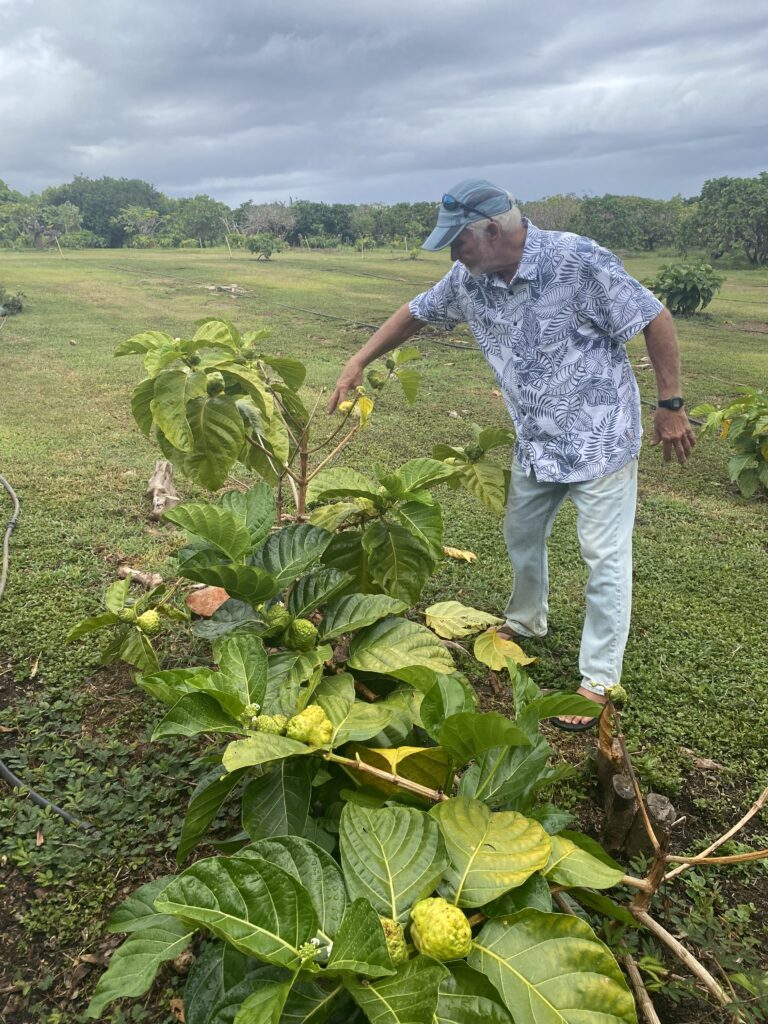
So there I was, standing on a noni farm in Kaua’i, watching my entire understanding of business marketing crumble like a stale cookie.
Let me back up.
The Setup: Two Years of Cosmic Intervention
My wife and I tried to visit Real Noni Farm two years ago. Our rental car had other plans. It died. We flew home without seeing the farm, and I figured fate was telling me something.
Turns out fate was just making me wait because I wasn’t ready for what I was about to witness.
Fast forward to June 26th, 2026. We finally made it. And what I learned from this family business has me questioning everything I thought I knew about marketing, scaling, and “growth hacking.”
The Tour Guide Was Actually The Founder (And A Walking Encyclopedia)
The tour guide? Yeah, that’s Steve. The founder. The dad. The guy who’s been doing this since the early 80s.
He left California farming because of pollution, came to Kaua’i, and spent YEARS figuring out what to do with his land. Eventually landed on noni – this Polynesian superfruit that almost no one else grows commercially.
But here’s where it gets interesting.
This man is a walking encyclopedia of organic farming, sustainable agriculture, farm business models, and – I kid you not – worm tea.
(Yes, worm tea is a thing. Yes, it’s fascinating. No, we’re not going down that rabbit hole right now.)
They Do EVERYTHING (And I Mean Everything)
Most businesses talk about “vertical integration” like it’s some fancy MBA concept.
These guys LIVE it.
They farm the noni. They process it with a proprietary method (more on this in a second). They make fruit leather, lotions, and products for humans AND pets. They distribute directly to customers worldwide.
Oh, and they’re off-grid with their power solutions because why not add that to the list?
It’s a multigenerational family operation. Steve’s kids now help run it. They control their entire supply chain from dirt to doorstep.
While farms across the country are struggling to survive, these folks found a way to thrive by focusing on something the rest of the world barely knows exists.
But First, Let’s Talk About The Elephant In The Room
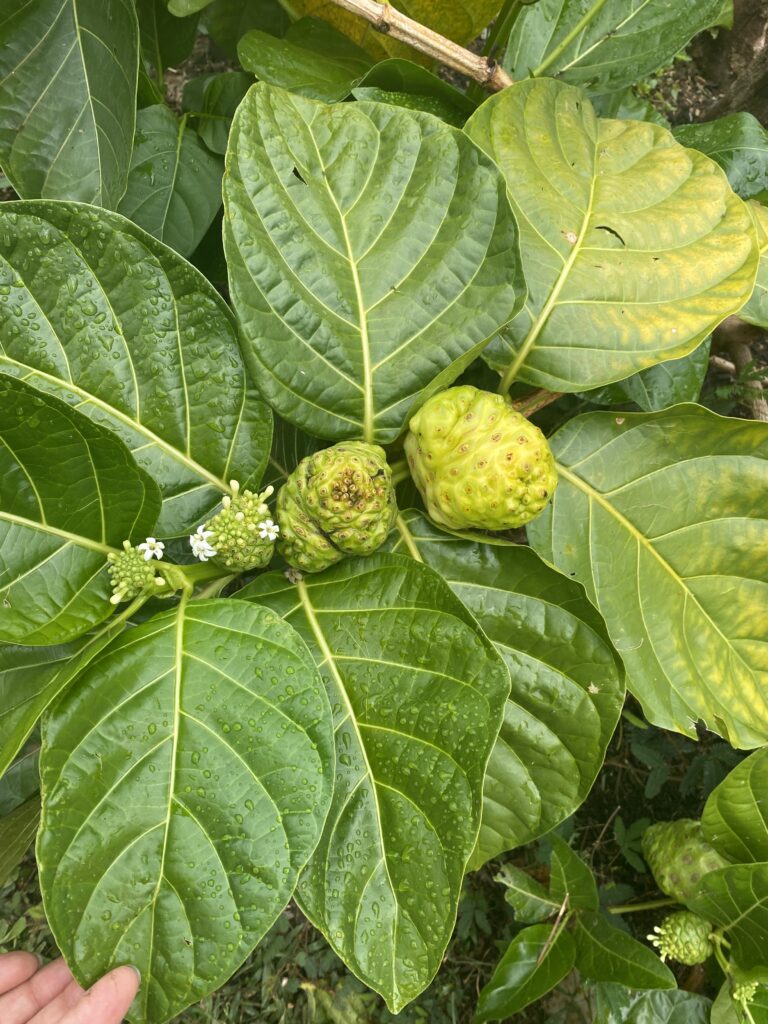
The stuff smells like old blue cheese.
And tastes worse.
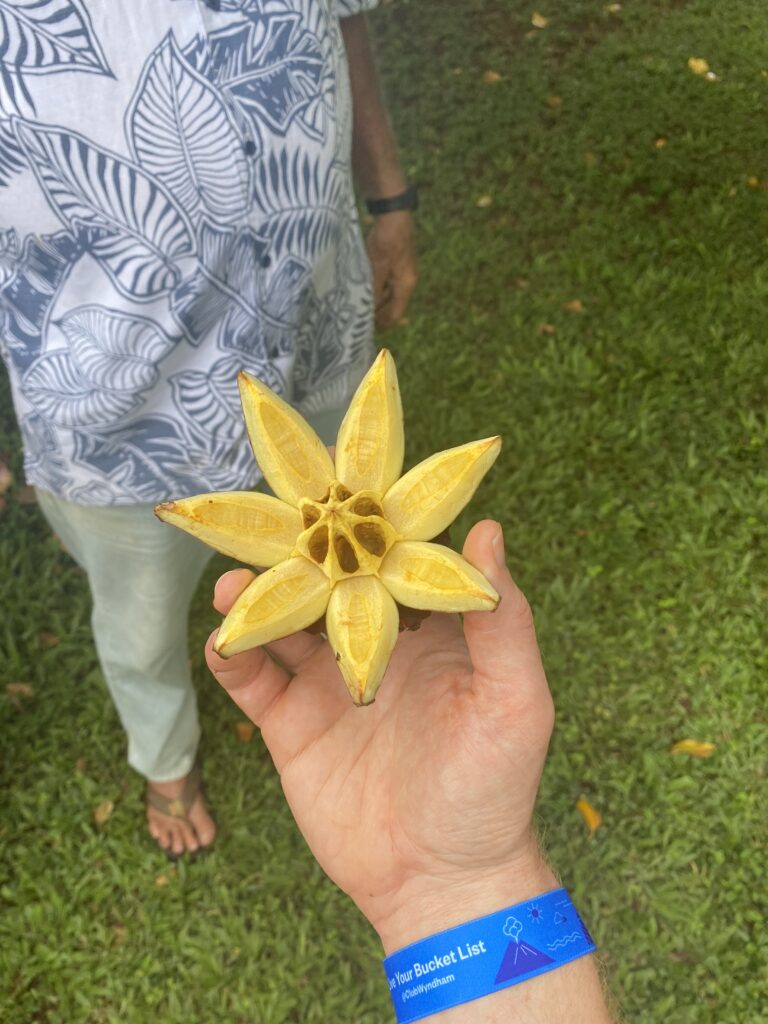
I’m not exaggerating. I’m not being dramatic. I ate some. I made it through part of a piece.
It was an experience.
Steve told us the old Polynesian stories – how people survived famines by eating noni. How they noticed they didn’t get sick. How they healed faster. (All the stuff we can’t technically say because, you know, FDA and all that.)
But here’s the thing: They didn’t eat this fruit because they WANTED to. They ate it because they HAD to.
Once other food became available? Yeah, they chose the OTHER fruit.
There are acquired tastes, and then there’s stuff you just don’t want to get stuck acquiring… like a case of gout.
And it’s not just the smell and taste. The fruit is full of inedible seeds. So you’re constantly putting some in your mouth, spitting out a bazillion seeds, which forces you to TASTE it more as you do it.
Yuck.
But wait, there’s more!
The really weird part? It made my entire mouth tingle. Not just my lips – my ENTIRE mouth. Like an antiseptic and pain number or something. It wasn’t unpleasant, exactly. Just… intense. Kinda cool in a way, I guess?
Very crazy sensation.
The Problem Nobody Else Could Solve
And THIS is where Steve’s genius comes in.
The reason noni hasn’t hit the mainstream market as it should is simple: To make it palatable, you literally have to make it no longer healthy.
Think about it.
Turn it into a nice-tasting juice? You’ve processed out all the good stuff.
Turn it into a capsule or powder? Same problem.
Do all the normal things to make something taste good, and you defeat the entire purpose.
That’s what Steve set out to solve.
And that’s why his processing method is locked away in another state.
The Secret Sauce (That’s Actually Secret)
They have a proprietary processing method for noni (specific use of adapted machines, inventions, and the overall process). Something about how they prepare the fruit that keeps the beneficial properties intact while making it actually consumable.
They went to patent it.
Their attorney told them: “DON’T.”
Keep it secret. Like Coca-Cola does with their formula.
The plans are literally locked away in another state.
I’m standing there thinking: “This is the most Willy Wonka thing I’ve ever heard, and I’m HERE FOR IT.”
Because here’s the thing: Only they can prepare the fruit correctly.
Not “we do it better than others.”
Literally: Only. Them.
Everyone else who tries to make noni products either makes them taste terrible (and nobody buys them) or makes them taste good (and destroys the benefits).
Steve figured out how to thread that needle.
And he’s not telling anyone how.
The Whole Foods Experiment (And Why They Walked Away)
Now here’s where the story gets really interesting.
They USED to be in Whole Foods. Multiple locations. They were expanding to the mainland. Doing webinars. Education campaigns. The whole nine yards.
And then people started making claims.
Not Steve. Not the farm. Random customers and distributors saying things about noni that – while possibly well-intentioned – could get Real Noni in serious trouble with the FDA.
You know how it goes. Someone gets excited about a product and starts making medical claims. “It cured my cousin’s neighbor’s dog’s arthritis!” That kind of thing.
Unsubstantiated. Unverified. And potentially lawsuit-inducing.
Steve and his family tried to educate. They did webinars explaining what they could and couldn’t say. They worked to control the narrative.
And then they made a decision that most business consultants would call insane:
They shut it all down.
Pulled out of Whole Foods. Stopped the mainland expansion. Walked away from retail distribution entirely.
Now they focus exclusively on direct-to-consumer sales.
Most businesses would see that as failure. As giving up. As leaving money on the table.
Steve saw it as protecting what they’d built.
Then I Made My Fatal Mistake
I’m a marketer. I can’t help myself.
After hearing this whole story, after tasting the fruit leather (which is actually good, by the way – he solved the problem!), after understanding the unique challenge of this product, I asked about affiliate programs. Referral programs. “Hey, do you want anyone on the mainland to promote your stuff?”
The answer?
“No.”
Not “we’ll think about it.”
Not “maybe in the future.”
Just… no.
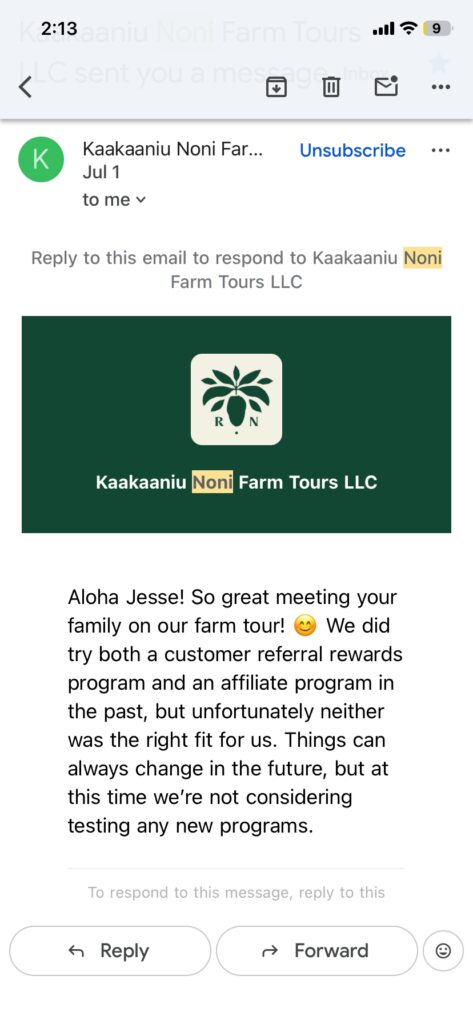
They even sent me a follow-up email (because they’re polite like that):
“We did try both a customer referral rewards program and an affiliate program in the past, but unfortunately, neither was the right fit for us. Things can always change in the future, but at this time we’re not considering testing any new programs.”
When I later ran into Steve at the Farmer’s Market, he dropped the bomb:
“We have too many customers.”
(I am paraphrasing, but I clarified this with him by letting him know he had the opposite problem as everyone else in business, and he confirmed.)
I’m sorry, WHAT?
Let That Sink In: “We Have Too Many Customers”
In what universe does a business say they have TOO MANY customers?
In the Real Noni universe, apparently.
They’re intentionally staying small. On purpose. By choice.
They could charge 10X what they’re charging, and people would pay it. The quality is there. The uniqueness is there. The story is there. The SOLUTION to an impossible problem is there.
But they don’t.
They keep prices fair. They keep the operation manageable. They focus on doing it RIGHT instead of doing it BIG.
The Marketing Lessons That Broke My Brain
Okay, let’s break down what’s actually happening here because this is GENIUS:
1. They Solved An Impossible Problem (And That’s The Entire Moat)
Most businesses compete on price, convenience, or customer service.
Real Noni competes on: “We can do something nobody else can do.”
Making noni palatable while keeping it beneficial isn’t just hard. It’s apparently impossible.
Unless you’re Steve.
And he’s not telling you how he does it.
That’s not a competitive advantage. That’s a MONOPOLY.
2. The Product Itself Creates Natural Barriers To Entry
You can’t just decide to compete with Real Noni.
Because even if you grow noni (good luck), you can’t process it correctly.
The raw fruit tastes like old blue cheese and makes your mouth tingle as if you’ve been to the dentist, and it goes bad and ferments within hours of coming off the tree.
Good luck building a customer base on that.
They tried freezing and freeze-drying all that kind of stuff, and everything had an issue or problem that ruined either the quality or the economics.
Steve spent YEARS figuring out how to make it work. And he’s keeping that knowledge locked away.
New competitors would have to start from scratch. And most would give up after their first taste test.
3. They Chose Control Over Scale
Most businesses chase scale at any cost.
Real Noni chose control.
When retail distribution threatened their ability to control the message (and protect themselves legally), they walked away.
That’s not fear. That’s WISDOM.
They’d rather be smaller and sustainable than bigger and vulnerable.
4. Direct-To-Consumer As A Moat
By going direct, they:
- Control the customer experience
- Control the messaging
- Control the education
- Avoid the “telephone game” of claims getting distorted
- Build direct relationships with people who actually GET it
No middlemen. No retailers making promises they can’t keep. No random people saying things that could trigger FDA investigations.
Just them, their products, and customers who took the time to learn what noni actually is (and why it smells the way it does).
5. Scarcity That’s Actually Real
Most businesses fake scarcity. “Only 3 left!” (Narrator: There were not only 3 left.)
Real Noni doesn’t need to fake anything. They literally turned down Whole Foods. They turn down marketing opportunities. They have too many customers.
That’s not a marketing tactic. That’s just… reality.
And it creates MASSIVE FOMO.
6. The “Hard To Get” Principle On Steroids
When someone doesn’t want your business, you suddenly want to give them your business SO MUCH MORE.
I offered to promote them for free (essentially). They said no.
And now I’m writing a 3,000+ word blog post about them.
FOR FREE.
They rejected me into promoting them harder.
That’s 4D chess, people.
7. Honesty About The Product (Which Builds Trust)
Steve doesn’t pretend noni tastes good in its natural form.
He tells you it smells like old blue cheese.
He tells you about the seeds.
He tells you about the mouth-tingling sensation.
He’s HONEST about the challenge.
Which makes his solution even more impressive.
And makes you trust everything else he says.
8. Learning From Mistakes (And Actually Changing Course)
Here’s what I respect most: They tried the traditional growth path. Retail. Distributors. Affiliates. Referral programs. Major distribution through traditional commercial networks.
It didn’t work for them.
So they STOPPED.
How many businesses keep doing things that don’t work just because “that’s how it’s supposed to be done”?
Real Noni said “nope” and charted their own course.
9. The Experience Creates The Story
You don’t just buy noni products from Real Noni.
You experience the farm. You taste the raw fruit (if you’re brave). You hear the Polynesian stories. You learn about the processing challenge. You meet Steve.
And then you become an evangelist.
Because you have a STORY to tell.
I can’t just say “I bought some fruit leather online.”
I have to tell you about the mouth-tingling, seed-spitting, blue-cheese-smelling experience.
That’s memorable. That’s shareable. That’s marketing gold.
10. Exclusivity Without Being Exclusive
They’re not trying to be exclusive. They’re not putting on airs. They’re just doing their thing exceptionally well, and the exclusivity happens naturally.
You can’t get their products anywhere else because they don’t sell anywhere else.
You can’t replicate their processing method because they won’t tell you how.
You can’t compete with them because the barrier to entry is too high.
It’s not manufactured scarcity – it’s actual uniqueness.
11. The Anti-Influencer Strategy
In 2026, everyone’s chasing influencers, affiliates, and viral moments.
Real Noni? Nah, we’re good.
No affiliate program. No influencer partnerships. No mainland promoters.
Just word-of-mouth from people who actually experienced the farm and the products.
And guess what? It works BETTER than any influencer campaign could.
Because when someone can’t profit from recommending you, their recommendation means MORE.
Plus, how do you even pitch this to an influencer?
“Hey, want to promote a fruit that smells like old blue cheese and makes your mouth tingle? No? Okay, cool.”
12. Education As The Moat
Most people don’t know what noni is. I certainly didn’t.
By controlling the education process (through tours, their website, and direct interaction), they control the narrative.
They’re not competing with “noni juice” brands because they’ve positioned themselves differently. They make fruit leather, lotions, and specialty products. They’re not in the juice game (which often has all the good stuff processed out anyway).
They created a category of one: Real Noni.
And they educate you on why everyone else’s noni products don’t work.
13. The Coca-Cola Play
That secret processing method? The one their attorney told them to keep secret?
That’s a MOAT.
Patents expire. Secrets don’t (if you keep them secret).
Coca-Cola has been doing this for over a century. Real Noni learned from the best.
Nobody can reverse-engineer what they don’t know exists.
And even if they could, they’d have to solve the same impossible problem Steve already solved.
Good luck with that.
14. Quality Over Quantity (And Actually Meaning It)
Every business says “quality over quantity.”
Real Noni actually lives it.
They could scale. They could go back to retail. They could raise prices. They could franchise, license, or do all the things business gurus tell you to do.
They choose not to.
Because scaling might compromise quality. And quality is the whole point.
Especially when your entire competitive advantage is that you can process this stuff correctly and nobody else can.
15. Long-Term Thinking In A Short-Term World
They’ve been at this since the 80s.
Not chasing quick wins. Not looking for an exit. Not trying to be acquired.
Just building something sustainable (literally and figuratively) that can be passed down to the next generation.
Patience as a competitive advantage.
In a world of “get rich quick,” they’re playing “get rich slow and actually enjoy the process.”
And solve really hard problems that nobody else wants to solve.
16. The Confidence Factor
There’s something magnetic about a business that doesn’t need you.
Most businesses: “PLEASE BUY FROM US! HERE’S 20% OFF! PLEASE!”
Real Noni: “We’re good, actually.”
That confidence is attractive. It signals value. It makes people want in.
Especially when that confidence comes from: “We can do something you literally cannot get anywhere else.”
17. Fair Pricing Despite Scarcity
Here’s the thing that really got me: They could absolutely gouge people.
Limited supply. Unique product. Secret process. High demand. No retail competition. Impossible-to-replicate processing method.
They could charge luxury prices.
They don’t.
Prices are fair. Reasonable. Accessible.
And that creates LOYALTY. People aren’t just customers – they’re advocates. Because they know they’re getting something special at a fair price.
That’s how you build a cult following without trying to build a cult following.
18. Protection Over Expansion
The Whole Foods story is the key to everything.
They could have fought it. Hired lawyers. Created compliance programs. Managed the risk.
Instead, they eliminated the risk entirely by changing the business model.
Sometimes the smartest business decision is knowing what NOT to do.
19. The “Only We Can Do This” Positioning
This is the ultimate marketing position:
Not “we’re the best at this.”
Not “we’re the cheapest at this.”
Not “we’re the most convenient at this.”
But: “Only we can do this.”
That’s not a competitive advantage.
That’s a category of one.
The Meta Lesson That Changed Everything For Me
Real Noni isn’t playing the “more customers” game.
They’re playing the “right customers who truly appreciate what we do” game.
And by saying NO to growth opportunities that don’t align with their values and risk tolerance, they’ve created more demand than any marketing campaign could generate.
They’ve built a business so good, so unique, and so well-positioned that they can afford to turn down Whole Foods, turn down affiliates, and turn down free marketing.
They solved a problem nobody else could solve (making noni palatable while keeping it beneficial).
They protected that solution like Fort Knox.
And they built a sustainable business around it.
That’s not anti-marketing.
That’s the ULTIMATE marketing.
What This Means For You (And Me)
I walked onto that farm thinking I might teach them a thing or two about marketing.
I walked off, realizing I had nothing to teach them. They’re already doing it better than most “experts” could ever dream.
Here’s what I’m taking away:
1. Maybe you don’t need more customers. Maybe you need better customers.
2. Maybe you don’t need to scale. Maybe you need to optimize what you already have.
3. Maybe saying “no” is more powerful than saying “yes” to everything.
4. Maybe walking away from revenue is sometimes the smartest move.
5. Maybe solving an impossible problem creates a bigger moat than any marketing strategy.
6. Maybe keeping some things secret is smarter than sharing everything.
7. Maybe slow and sustainable beats fast and fragile.
8. Maybe “too many customers” is actually a thing, and it’s okay to turn people away.
9. Maybe protecting what you’ve built matters more than expanding it.
10. Maybe learning from what DOESN’T work is more valuable than copying what works for someone else.
11. Maybe being honest about your product’s challenges builds more trust than pretending they don’t exist.
12. Maybe the best marketing is just being so darn good at what you do that people can’t help but talk about you.
13. Maybe creating an experience (even one that involves mouth-tingling and seed-spitting) is more valuable than creating a transaction.
The Irony Of It All
They rejected my offer to promote them.
And now I’ve written this entire article promoting them.
They said no to affiliates.
And I’m basically being an unpaid affiliate right now.
They don’t want mainland promoters.
And here I am, on the mainland, promoting them.
They pulled out of Whole Foods to avoid uncontrolled messaging.
And I’m here writing 3,500 words about them completely outside their control.
Including descriptions of how their product smells like old blue cheese and makes your mouth tingle.
(You’re welcome, Steve.)
They played me like a fiddle, and I’m not even mad about it.
Actually, I’m impressed.
No, I’m in AWE.
This is marketing at its finest: Create something so good, with such a compelling story, that people promote it even when you tell them not to.
Even when you’ve specifically structured your business to AVOID this kind of promotion.
Even when the product smells like old blue cheese.
Final Thoughts
If you’re ever in Kaua’i, go visit Real Noni Farm. The tour is incredible. The products are legit. The story is inspiring.
Try the raw fruit if you’re brave. Experience the mouth-tingling sensation. Spit out the seeds. Smell the blue cheese aroma.
Then try the fruit leather and marvel at the fact that Steve figured out how to make this stuff actually enjoyable while keeping it beneficial.
But more importantly, study what they’re doing from a business perspective.
Because in a world of “growth hacking,” “scaling,” and “disruption,” sometimes the most disruptive thing you can do is just…
Solve a problem nobody else can solve.
Keep your solution secret.
Be really, really good at one thing.
Stay small on purpose.
Say no to opportunities that don’t align.
Walk away from revenue that comes with too much risk.
Charge fair prices.
Build something sustainable.
Control your distribution.
Be honest about the challenges.
And let the right people find you.
That’s not just good marketing.
That’s good LIFE.
P.S. – I asked Steve about worm tea for like 20 minutes. It’s fascinating. He has a wealth of knowledge. If you go, ask about the worm tea. You won’t regret it.
P.P.S. – They still won’t let me be an affiliate. And somehow that makes me want to promote them even more. Well played, Real Noni. Well played. If you buy from them, tell them Jesse sent you anyway 😉
P.P.P.S. – The fact that they walked away from Whole Foods distribution to protect their business might be the gutsiest move I’ve seen in years. Most people would kill to get INTO Whole Foods. They got in, saw the problems, and got OUT. That’s next-level strategic thinking.
P.P.P.P.S. – My mouth is still tingling a little bit. Is that normal? Should I be concerned? Actually, you know what, I’m not even going to ask. It’s part of the experience now.
Want more stories about businesses doing marketing brilliantly (often by accident)? You’re reading the right blog. Subscribe, don’t subscribe, I’m not going to beg. See? I learned something from Real Noni already.
