What The Devil Wears Prada Taught Me About Leadership, Standards, and the Cost of Excellence
The older I get, the more I root for the villains in business movies.
Hollywood would probably cancel me for saying that, but I can’t help it.
Yesterday, my wife and daughter wanted to watch The Devil Wears Prada. I moped around because in my mind, it was just some fashion movie from years ago. Figured I’d sit there half-paying attention.
Then something disturbing happened.
By the end, I was cheering the loudest.
Not for Andy.
For Miranda Priestly.
Which, apparently, is what happens after you’ve spent enough years running businesses that help other businesses.
When I first watched this movie, I saw what everyone else saw: a cold, demanding fashion tyrant with impossible standards.
Now?
Now I watch it like a tired agency owner watching a documentary about operational excellence.
Somewhere along the line, I stopped identifying with Andy, the overwhelmed assistant shocked by the pace of elite performance.
I started identifying with the woman quietly wondering why nobody solved the obvious problem before bringing it into her office.
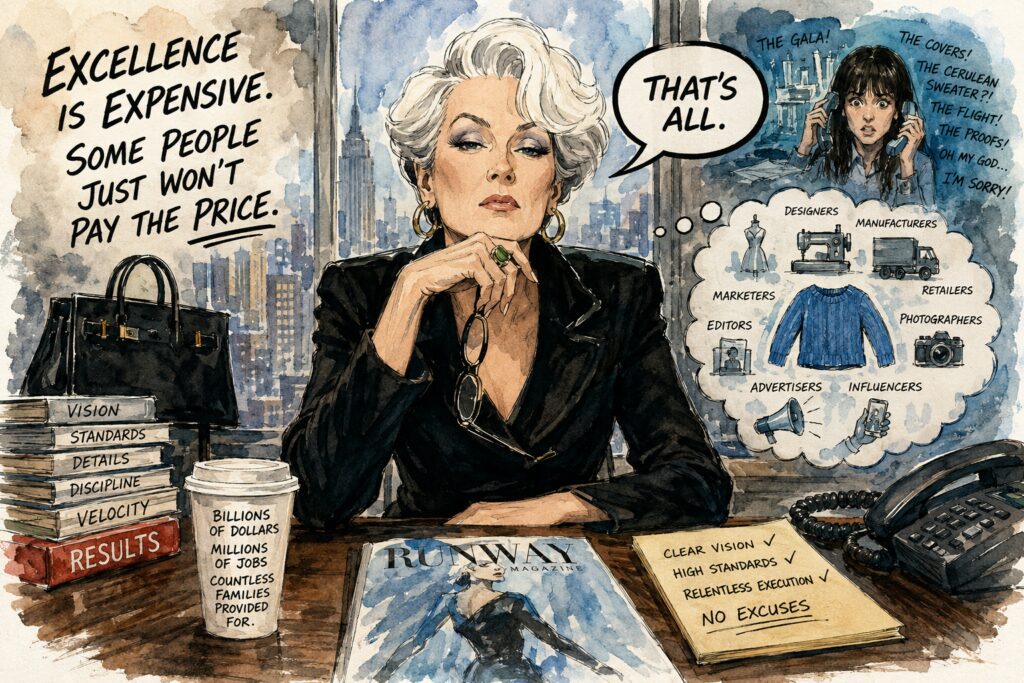
“That’s all.”
That line used to sound cruel.
Now it sounds efficient.
What changed?
I started running a business.
Suddenly, all the “villains” in business movies started looking less evil and more exhausted.
Movies train us to distrust intensity. The corporate executive is always the antagonist. The CEO is greedy. The high-performing boss is controlling, obsessive, cold, divorced, or secretly miserable.
Meanwhile, the protagonist is the emotionally balanced underdog who teaches everyone that relationships matter more than ambition.
Which is wonderful.
Unless you’ve ever had to make payroll.
Once you’ve hired people, managed clients, fixed mistakes, solved emergencies, absorbed financial risk, and carried responsibility for an entire organization…these stories start to feel selective.
The so-called villain is usually the only person in the room who fully understands the stakes.
Miranda Priestly is introduced like a supervillain.
The office panics when she arrives. People scatter. Grown adults hide.
The movie frames this as absurd.
But if you’ve ever run an agency, you know exactly why everyone’s nervous.
Standards matter.
Details matter.
Elite organizations are fragile.
Reputations take years to build and five minutes to destroy.
When enough small mistakes pile up, the entire machine breaks.
Miranda understands this instinctively.
That famous “cerulean sweater” speech is one of the best business monologues in modern film. Andy dismisses fashion as superficial, and Miranda calmly explains that the sweater she’s wearing was selected through a massive ecosystem of designers, manufacturers, marketers, editors, retailers, and supply chains spanning the globe.
Entire industries exist because of taste, branding, and consumer psychology. Billions of dollars move through that ecosystem. Millions of jobs exist because somebody decided cerulean blue was fashionable that season.
And Andy is standing there acting like it’s just “a blue sweater.”
That scene hits differently once you’ve built something.
Entrepreneurs understand systems.
We understand leverage.
We understand that entire economies are built on things outsiders dismiss as trivial.
Miranda isn’t criticizing a sweater.
She’s explaining invisible infrastructure.
Entrepreneurs spend half their lives obsessing over tiny details nobody else notices.
The headline. The font. The timing. The funnel. The positioning. The follow-up. The onboarding sequence. The wording of a subject line.
The difference between “pretty good” and world-class.
The outside world calls this obsessive.
Customers call it professionalism.
Modern culture has become strangely uncomfortable with intensity itself.
We confuse urgency with toxicity.
We confuse standards with oppression.
We confuse decisiveness with cruelty.
And we romanticize calmness as if relaxed people automatically produce extraordinary results.
Sometimes they do.
But not usually in the beginning.
Especially not in entrepreneurship.
A lot of modern leadership advice feels like it was written for organizations that are already stable, profitable, and functioning.
That’s very different from trying to build momentum out of thin air.
Startups, agencies, and growing businesses operate in uncertainty.
Nobody fully knows what’s going to work.
Nobody has a perfect map.
And that’s where I increasingly relate to Miranda Priestly.
Not because she’s mean.
Because she understands velocity.
She understands that elite performance emerges from enormous amounts of activity, experimentation, iteration, correction, and repetition.
Richard Koch’s 80/20 Principle says that roughly 20% of actions produce 80% of results.
Everybody quotes that line like it’s some magical productivity cheat code.
Here’s the uncomfortable part nobody talks about:
How do you know which 20% matters before you’ve done the work?
You usually don’t.
Entrepreneurs discover the productive 20% through massive amounts of exploration, testing, activity, failure, and chaos.
The successful marketing campaign comes after fifty weak ones.
The winning sales process comes after endless awkward conversations.
The great hire comes after bad hires.
The profitable system emerges from the messy process of trying things.
Which means activity matters more than modern productivity gurus like to admit.
But inactivity almost never discovers greatness either.
That’s the tension.
Dan Kennedy’s philosophy is basically the opposite of modern corporate therapy culture.
He believes standards must be enforced, accountability matters, time theft destroys businesses, weak performance spreads, and leadership requires uncomfortable decisions.
Buried underneath the aggression is an uncomfortable truth many founders eventually learn:
Businesses decay when standards decay.
That’s why Miranda resonates with entrepreneurs.
She sends a signal: This matters. The details matter. The timing matters. The execution matters. The quality matters.
No, she isn’t emotionally balanced.
But she is absolutely committed to excellence.
And the older I get, the harder it becomes to dismiss that commitment.
If Miranda Priestly were a man, audiences would describe her as demanding, brilliant, driven, intimidating, powerful, elite.
Instead, she’s framed as monstrous.
The movie subtly punishes ambition itself.
Miranda’s success is portrayed as morally expensive. Her marriages fail. Her relationships collapse. Her life becomes isolated and transactional.
And I actually think the movie is partly right.
Miranda’s flaw isn’t ambition.
It’s imbalance.
She compressed herself into pure function. She became so optimized for excellence that she sacrificed softness, accessibility, rest, intimacy, and emotional presence.
That’s tragic.
But tragedy doesn’t erase achievement.
The film wants us to choose: career or humanity, excellence or relationships, success or soul.
Real life is more complicated.
The goal isn’t to become Miranda Priestly.
The goal is to understand why she became Miranda Priestly in the first place.
Because many founders quietly drift in that direction over time.
At first, you just want to succeed.
Then you realize success requires standards.
Then you realize standards require pressure.
Then you realize pressure changes people.
Then one day, somebody brings you a half-finished project, and you accidentally say something in a tone that causes emotional weather damage across three departments.
And suddenly you’re one silk scarf away from becoming the editor of Runway Magazine.
I’m increasingly suspicious of leadership philosophies that pretend intensity isn’t part of greatness.
Elite athletes train intensely.
Elite musicians practice intensely.
Elite military units operate intensely.
Elite companies function intensely.
Yet, somehow, in business, we pretend that extraordinary results should emerge from relaxed energy, soft accountability, and vague standards.
Maybe.
But probably not consistently.
The answer isn’t abuse or fear.
The answer is balance.
But balance is harder than choosing sides.
It’s easy to become a tyrant.
It’s easy to become passive.
What’s difficult is maintaining high standards without losing your humanity.
Not rejecting intensity entirely.
Harnessing it without letting it consume you.
The Devil Wears Prada is really a story about the cost of excellence.
Andy chooses balance over ambition.
Miranda chooses ambition over balance.
The audience is supposed to feel relieved by Andy’s choice.
But the older I get, the more I understand Miranda.
Not because she’s kind or emotionally healthy.
But because she understands something most people don’t:
Excellence is expensive.
And sometimes the people we call villains are simply the ones willing to pay for it.
That’s all.
